Miscellaneous Sailing Knowledge
This section covers some other useful information.
Wind Direction Convention
Sailbot software represents wind using the flow-toward convention: the angle points in the direction the air travels. In global true-bearing coordinates, 0° is airflow traveling toward north (from south), 90° is airflow traveling toward east, and angles increase clockwise.
This differs from the meteorological/source convention commonly used in spoken sailing descriptions. A source bearing points to where the air originated, so it is 180° opposite the flow-toward bearing. Convert a source bearing to a Sailbot flow bearing by adding 180° and normalizing it to the required range.
Wind velocity vectors, true-wind parameters, apparent-wind calculations, and
WindSensor.direction all use flow-toward values unless an external interface
explicitly states otherwise.
Navigation Terms
Heading
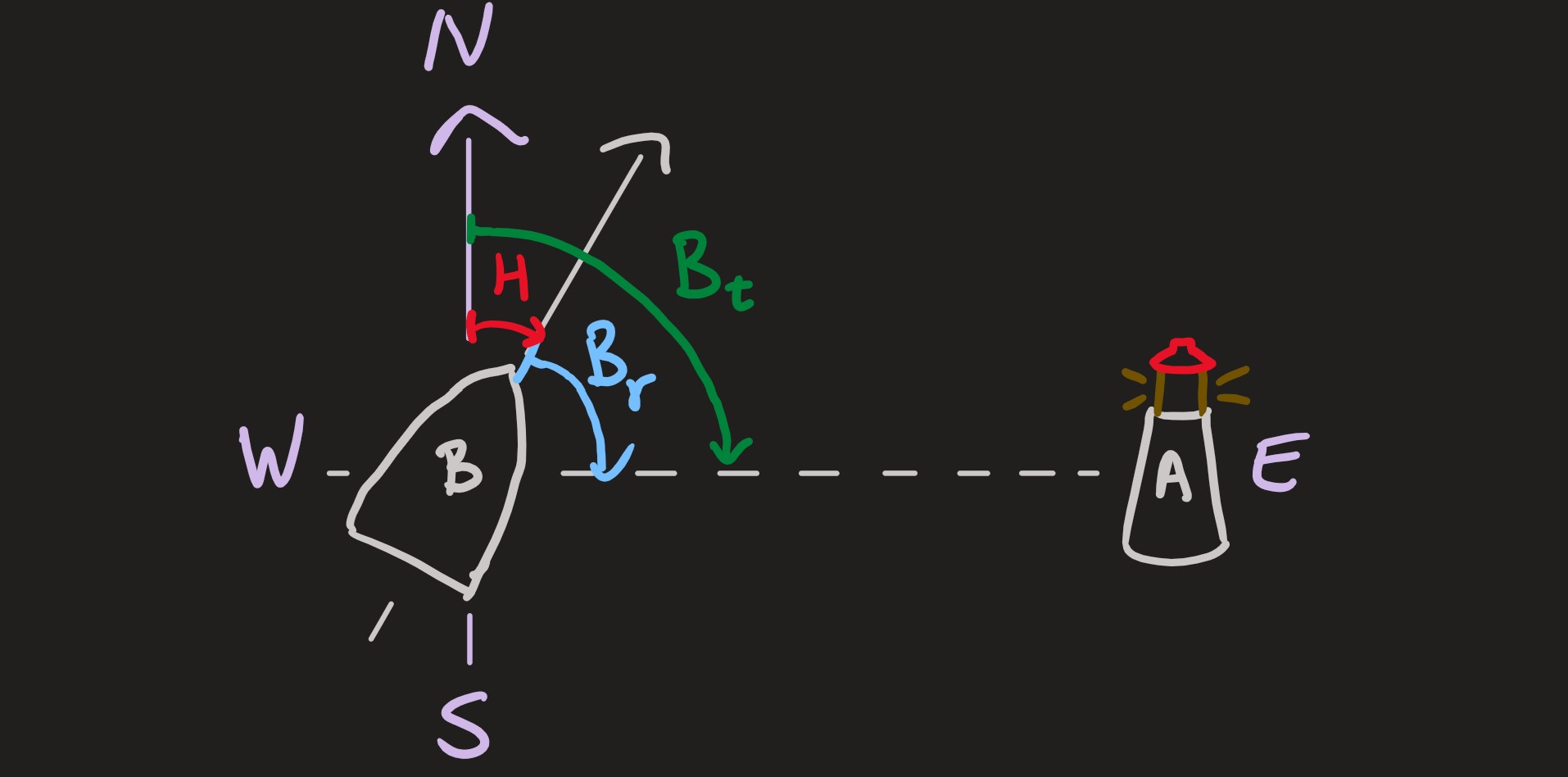
In navigation generally (outside of Sailbot), the Heading is the direction the bow of the boat is pointing towards. Headings are typically (but not always at Sailbot) measured relative to true North in the clockwise direction.
Bearing
A Bearing is used to describe one point in relation to another: the Bearing of point "A" from point "B" is the direction you would would look towards if you wanted to see point "A" while standing at point "B". A Range is the distance between points "A" and "B", so that a Bearing and Range together can locate point "A" relative to point "B" in polar co-ordinates. There are two main ways of measuring bearings:
- A True Bearing is a bearing where the angle convention is as follows: 0° is towards the North, angles increase in the clockwise direction, and angles are typically bounded within [0°, 360°)]
- A Relative Bearing is a bearing where the angle convention is as follows: 0° is straight forwards relative to the boat, and angle measurements increase in the clockwise direction. Angles may be bounded in [-180°, 180°) or [0°, 360°)
In the example below, the boat "B" has a Heading (H) of 30°. The True Bearing (\(B_t\)) of the Lighthouse "A" from the boat is 90°. The Relative Bearing (\(B_r\)) of the lighthouse from the boat is 60°.
Track Made Good
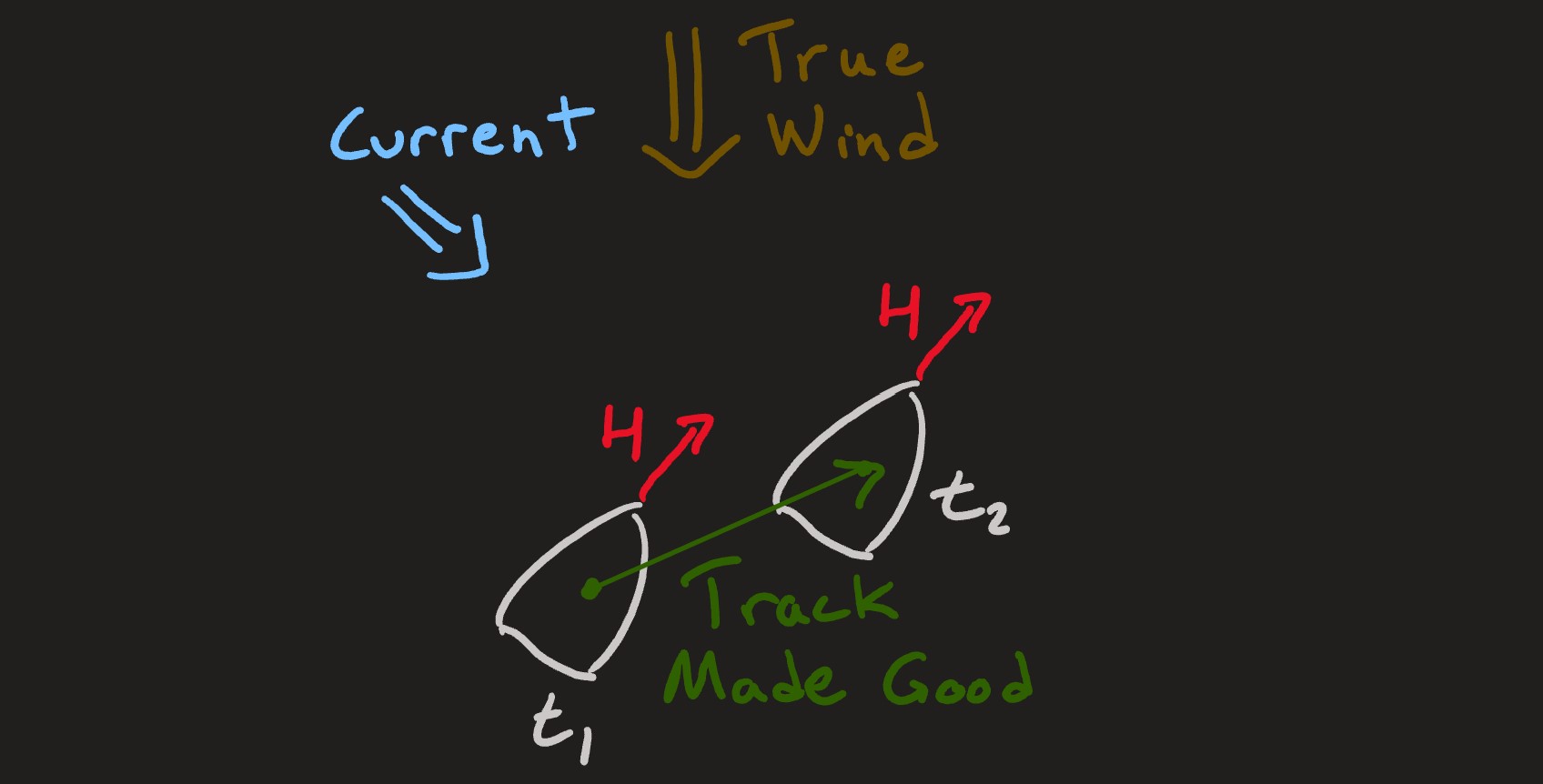
Boats do not necessarily travel in the same direction as their Heading, due to the effects of ocean current and wind. The path the boat has traveled relative to the sea floor is called the Track Made Good. This is the same as if you measured motion compared to land or with a GPS.
Heading and Bearing in Raye Project
In Sailbot's Raye project, Heading and Bearing are used to refer to different conventions for describing which way the boat is pointing. The following 3 pieces of information are needed to unambiguously define an angle measuring convention:
- What does 0° mean? If 0° is North, is it towards the North or away from the North?
- Do the angle measurements increase in the clockwise or counter-clockwise direction?
- What range should the angles be bounded to? This part is often unimportant if the angles are only used in trigonometry functions.
Some common examples of angle measuring conventions which we use are:
- 0° means towards the East, angles increase in the counter-clockwise direction, and angles are bounded in [-180°, 180°). This is effectively the main angle convention used in most math courses.
- 0° means towards the North, angles increase in the clockwise direction, and angles are bounded in [0°, 360°). This angle convention is more commonly used by navigators.
The specific angle conventions which we call Heading and Bearing can be ambiguous, and may be subject to change, so they are deliberately omitted here. Refer to the applicable source code to determine what the angle conventions are.
True, Apparent, and Boat Wind
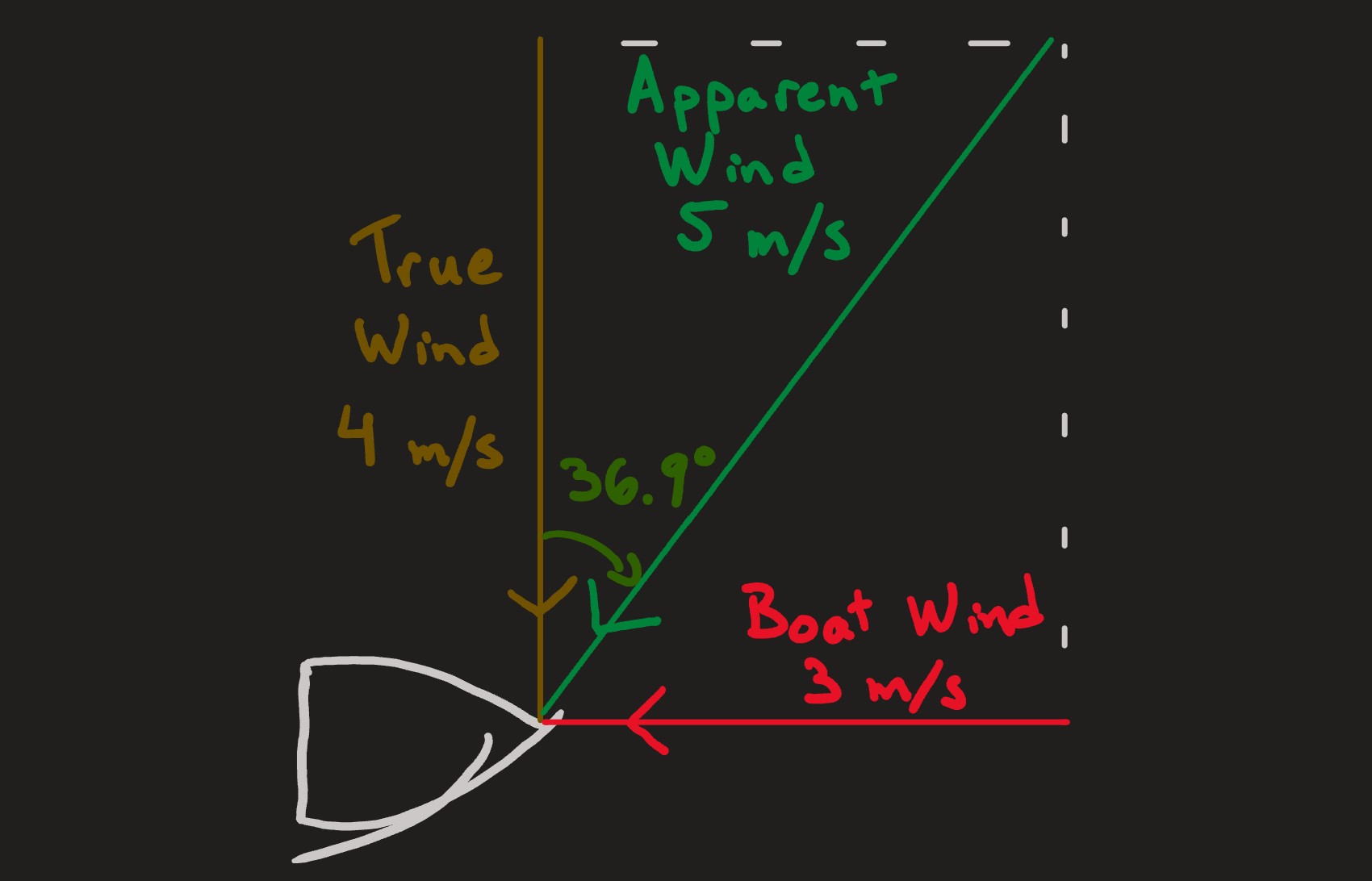
- True Wind is the airflow vector (speed and flow-toward direction) which you would measure while standing on land (or motionless at sea with unchanging GPS co-ordinates). In sailbot code, this may be referred to as Global Wind. When people refer to "the wind", they normally mean True Wind.
- Boat Wind is the airflow vector which you would measure while standing on a moving boat when the True Wind speed is 0. This means that boat wind always flows directly opposite the boat heading, toward the stern, and has magnitude equal to the boat speed.
- Apparent Wind is the vector sum of the True Wind and the Boat Wind. This is the wind that you would measure while standing on a moving boat more generally, even if there is non-zero wind. The apparent wind is also what our wind sensors measure, and what our sails feel. In Sailbot code, Apparent Wind may be referred to as Measured Wind.
In the example below, suppose true airflow travels south at 4 m/s (flow bearing 180°), and the boat moves east at 3 m/s.
- The True Wind flow bearing is 180° at 4 m/s.
- The Boat Wind flows west at 3 m/s, with flow bearing -90°.
- The Apparent Wind onboard the boat has a magnitude of \(\sqrt{3^2 + 4^2} = 5 \text{ m/s}\) and flows southwest with a true-bearing direction of approximately -143.1°.
Tack
In the Types of Turn page, we discussed how a Tack is a type of turn. Weirdly, the word "tack" actually has two more distinct meanings in sailing. The word "Tack" can refer to:
- the type of turn, as covered before.
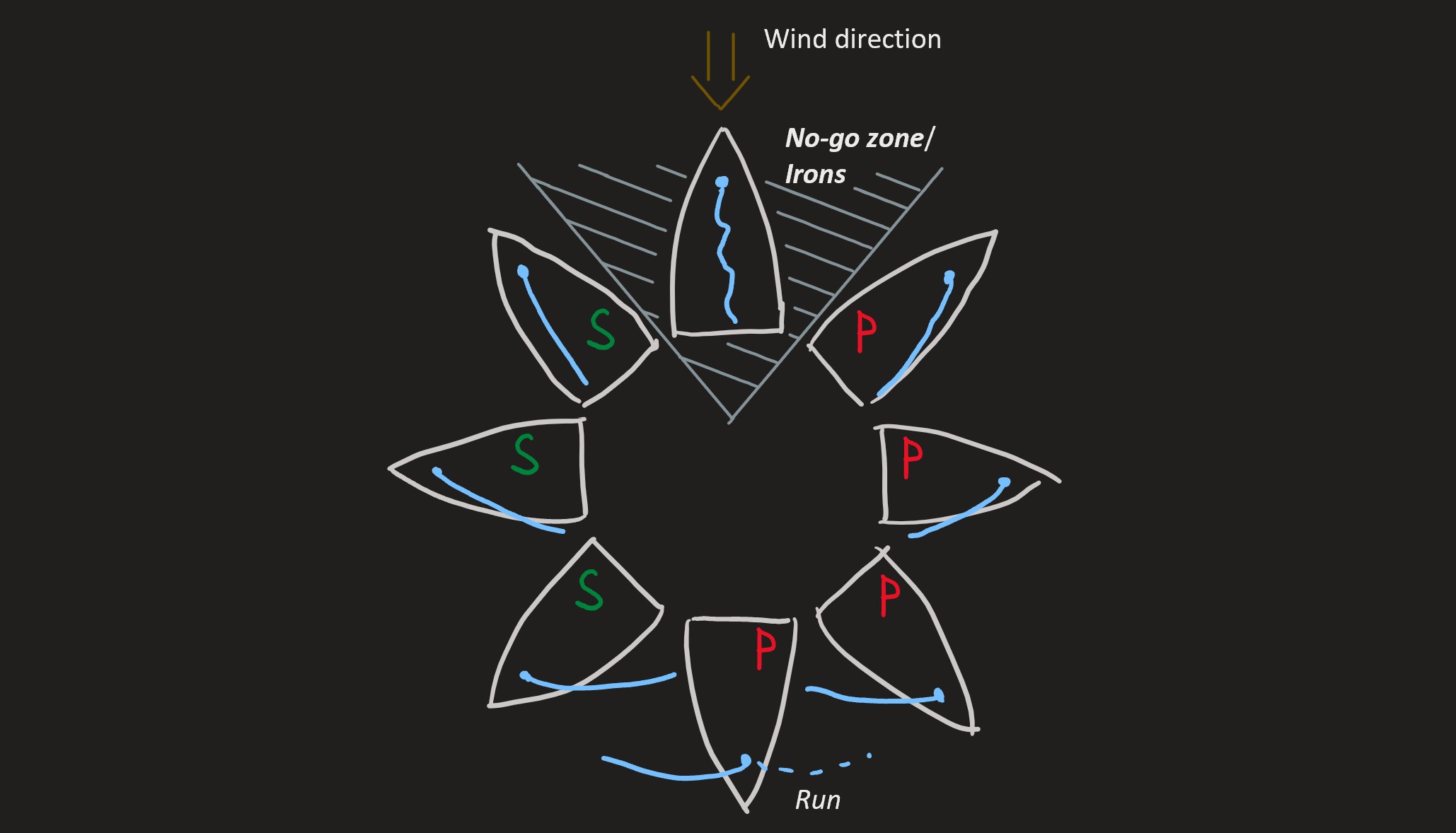
- Starboard Tack vs Port Tack: The tack is basically the side of the boat
which is further upwind. More thoroughly, the tack is the opposite side to
the sail. This means that boats change tack when the sail switches sides.
- In the diagram below, the 3 boats on the left of the diagram are on Starboard Tack, and the 3 boats on the right side are on Port Tack.
- The tack of a boat in Irons is undefined.
- The boat in the diagram on a run is on Port Tack. If the boat continued straight but the sail switched sides into the position shown by the dashed line, the boat would be on Starboard Tack.
- Finally, the Tack can refer to particular region of the main sail. This is not important for software members.
Keywords on this Page
- Heading
- Bearing
- Track Made Good
- Global Wind (aka True Wind)
- Measured Wind (aka Apparent Wind)
- Tack